
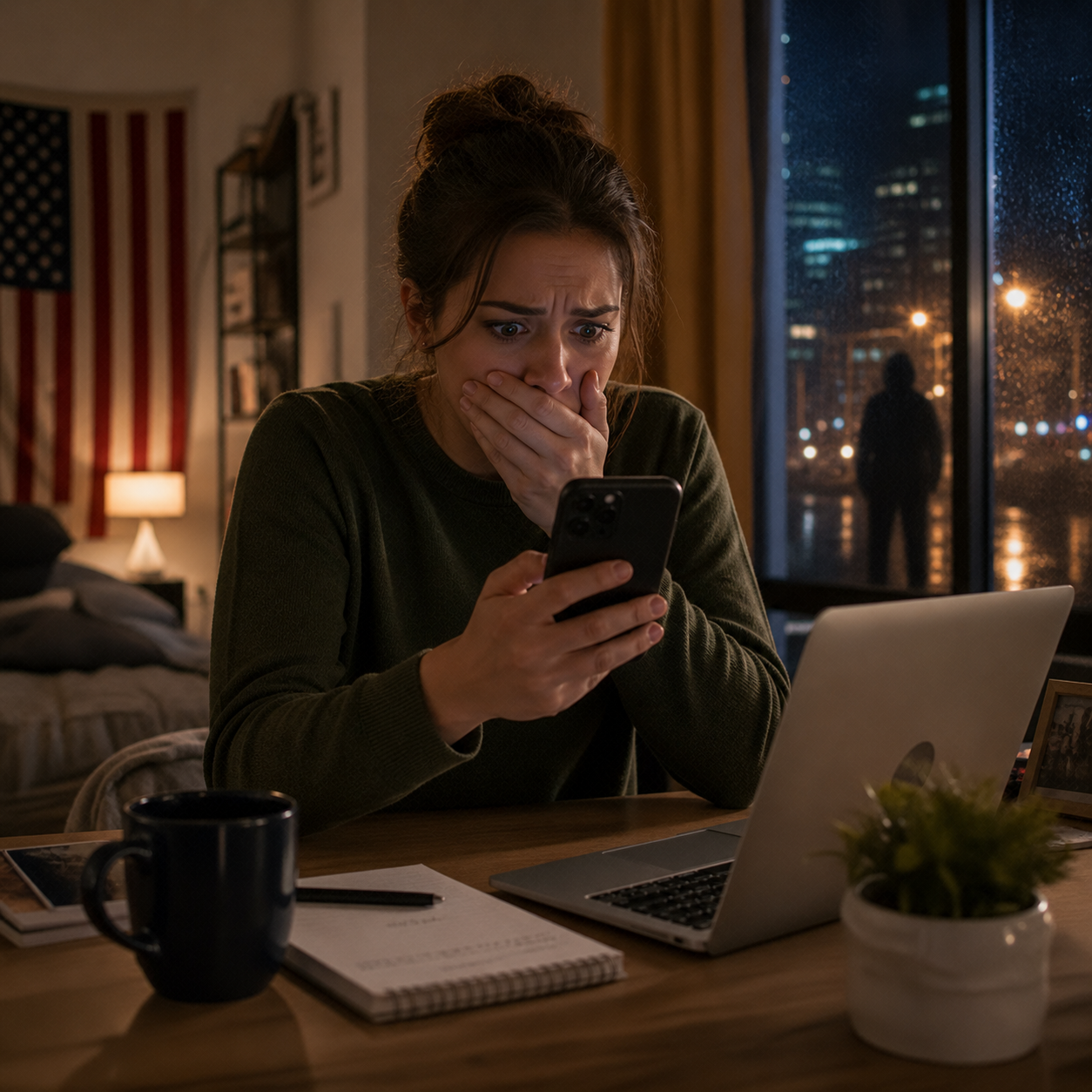
My cousin texted, "Your stalker ex was just released from prison and has your address." I stared at the message for 30 seconds before my hands started shaking so badly I almost dropped my phone. Marcus, after 3 years behind bars, he was out and somehow he'd already found me. I had moved across the country, changed my last name, deleted every trace of my old life online, but none of it mattered if he had my address.
Hey viewers, before we move on to the video, please make sure to subscribe to the channel and hit the like button if you want to see more stories like this. My cousin Tyler followed up immediately. Prison buddy told me, "Marcus has been planning this for months. Dude's obsessed. You need to run now. The apartment suddenly felt exposed.
Every window a potential entry point. Every shadow a hiding place." I grabbed my laptop and started searching for flights out of the city. my cursor hovering over destinations that were far enough away but close enough to drive back if needed. But where could I go that Marcus wouldn't eventually find me? He tracked me down before when I thought I was safe.
3 years ago, I'd gotten a restraining order after he broke into my apartment and waited in my bedroom closet for 6 hours until I came home from work. The look in his eyes when I found him sitting on my bed holding my favorite sweater still haunted my nightmares. He'd been calm, almost gentle, as he explained how we belonged together and how I'd understand eventually if I just stopped fighting what was meant to be.
The police had arrested him that night, but Marcus had violated the restraining order 17 times in the following months, showing up at my job, following me to the grocery store, leaving gifts on my car windshield with notes about how patient he could be. The final incident happened when I was having dinner with friends at a restaurant downtown.
Marcus had somehow gotten a job as a delivery driver just so he could walk into the restaurant and approach our table. He knelt down beside my chair and proposed with a ring he'd made from braided prison commissary bags, speaking loudly enough for the entire restaurant to hear about how our love had survived his temporary absence.
The other diners had thought it was romantic until they saw my face. My friend Rebecca had called 911 while Marcus continued his speech about destiny and soulmates. When the police arrived, he'd calmly handed over the ring and told them he understood I needed more time to process my feelings. That was the incident that finally got him 3 years in state prison for stalking and violating a protective order.
3 years that I'd used to build a new life in Seattle, thinking distance and time would keep me safe. I called Tyler back immediately. How did he get my address? I don't know all the details, but his cellmate said, "Marcus spent the whole 3 years researching you. had photos printed from your social media before you deleted everything.
Knew about your job, your apartment, even your favorite coffee shop. My stomach dropped. What photos? I deleted everything before I moved. Old screenshots, cashed pages, stuff friends posted and tagged you in. He had this whole system of keeping track. His cellmate thought it was romantic at first until Marcus started talking about how you were just confused and needed to be reminded of what you meant to each other.
I looked around my studio apartment. really seeing it for the first time as Marcus would see it. Ground floor with windows facing the parking lot. No security system, just a chain lock and a deadbolt that anyone with basic tools could defeat. One exit through the front door. No back way out. I'd chosen it because it was affordable and close to work.
Never thinking about defensibility. Tyler, I need you to do something for me. Call Detective Walsh Seattle PD and tell her Marcus Wright was released from Mil Haven Correctional and has made threats. Tell her I need to reactivate my case file. Already did that. She's on her way to your place now. Relief flooded through me. Detective Walsh had handled my original case before I moved and she'd been the one to suggest I relocate when Marcus behavior escalated.
She understood how dangerous he was and wouldn't dismiss this as paranoia. 20 minutes later, Detective Walsh knocked on my door with a uniformed officer beside her. I recognized her immediately. mid-4s, short brown hair, the kind of steady presence that made you feel like someone competent was finally handling things. Tyler filled me in, she said without preamble.
We're treating this as an active threat. How long ago did you get the warning? About an hour ago, she nodded and pulled out her phone. I'm calling this into the task force. Marcus Wright is considered high risk and his release should have triggered automatic notification to victims. Someone dropped the ball on protocol.
The uniformed officer started walking around my apartment, checking windows and door locks while Detective Walsh interviewed me. She wanted to know about any contact I'd had with Marcus or his associates, any suspicious activity around my building, any feeling that I was being watched. I told her about the weird phone calls I'd been getting for the past week.
Someone would call, I'd answer, and then they'd hang up without saying anything. I'd assumed it was telemarketers or wrong numbers, but now it felt sinister. Those calls started exactly 7 days ago. I said, checking my phone log, always from different numbers. Always during the day when I'd normally be at work. Detective Walsh made notes while the uniformed officer finished his security assessment.
The news wasn't good. My apartment was what he called tactically indefensible with too many access points and no safe room to retreat to if someone got inside. You can't stay here tonight, Detective Walsh said firmly. We're going to set up surveillance on the building, but Marcus is smart and patient.
He'll wait until we're not watching, then make his move. Where am I supposed to go? I can't afford a hotel indefinitely. There's a safe house program for high-risisk domestic violence cases. It's not luxurious, but it's secure and confidential. Can you pack a bag quickly? I threw essentials into my largest suitcase while the officers waited.
Changes of clothes, toiletries, my laptop, important documents the pepper spray Detective Walsh had given me three years ago that I'd carried every day since. As I packed, my phone buzzed with a text from an unknown number. Welcome home, beautiful. I missed you so much. My hands started shaking again as I showed the message to Detective Walsh.
She immediately called it in to her text specialist and had me forward the number for analysis. This confirms he's actively monitoring you, she said. The timing isn't coincidental. He sent this right as we were discussing moving you to safety. The safe house was a nondescript duplex in a residential neighborhood 30 minutes outside the city.
No signs, no obvious security features, just a normal looking home on a quiet street. But when Detective Walsh knocked on the door, I noticed the reinforced frame and multiple deadbolts. A woman in her 50s answered, introducing herself as Linda, the house coordinator. She had the weathered look of someone who'd seen too much but still cared enough to help.
We have protocols here that keep everyone safe, Linda explained as she showed me to a small room with a twin bed and a dresser. No contact with outside people unless cleared through me first. No social media, no posting photos, no sharing this address with anyone. The room was basic but clean with heavy curtains and a window that had bars disguised to look decorative.
Linda handed me a prepaid phone and explained that my regular phone would need to stay turned off except for essential calls made through their secure system. Marcus is technologically sophisticated. Detective Walsh had warned me. He can track your phone's location, monitor your calls, even access your photos and messages if he's installed spyware.
We're treating this like he has full access to your digital life. That first night in the safe house, I lay awake listening to every sound. The house had three other women staying there, each with their own horror story of escalating violence and failed legal protection. We didn't share details, but the understanding between us was immediate.
We all knew what it felt like to be hunted by someone who claimed to love us. Linda had installed a check-in system where each resident had to verify they were safe every few hours by pressing a button in their room. If someone missed two check-ins, armed security would respond immediately. It was both reassuring and terrifying to need that level of protection.
Detective Walsh called the next morning with an update that made my blood run cold. We found Marcus car parked three blocks from your apartment building. He's been there since yesterday afternoon just watching and waiting. Is he still there? No, the car is gone now, but we found something in the vehicle when we towed it. She paused. Photos of you taken recently.
You walking to work coming out of your building at the coffee shop on Fifth Street. He's been surveilling you for at least 2 weeks. The photos proved that Marcus had found me long before Tyler's warning. He'd been watching, learning my routines, planning his approach. The sick feeling in my stomach intensified as I realized how exposed I'd been, going about my daily life while a predator studied my every move.
There's more. Detective Walsh continued, "We found a journal in his car. Detailed entries about your daily schedule, descriptions of your clothes, speculation about your relationships with co-workers and neighbors. He's been building a psychological profile of your current life." What kind of speculation? He's convinced you're being controlled or manipulated by other people.
The journal entries suggest he believes you want to reconcile but can't because of outside influence. He's identified several people he considers threats to your relationship. My mouth went dry. What kind of threats? Your boss, your downstairs neighbor who you sometimes talk to, the barista at your coffee shop who knows your name.
Marcus has detailed descriptions of all of them and notes about how to remove their influence from your life. The scope of Marcus obsession was staggering. He wasn't just focused on me. He'd built an entire conspiracy theory about who was keeping us apart. In his mind, I was a victim who needed to be rescued from the people manipulating me.
That level of delusion made him infinitely more dangerous because he genuinely believed he was saving me rather than terrorizing me. Detective, I need to warn my co-workers if he thinks they're threats. Already on it. We've notified your employer and recommended enhanced security at your workplace. Your boss is cooperating fully with our protective measures.
Linda knocked on my door that afternoon and said I had a visitor in the common room. Detective Walsh was there with a woman I didn't recognize, blonde, maybe 40, with a kind of sharp intelligence that suggested law enforcement training. This is Agent Coleman from the FBI. Detective Walsh said, "Marcus case has been elevated to federal level due to his pattern of interstate stalking and the sophisticated nature of his surveillance methods.
Agent Coleman sat down across from me with a thick file. We've been tracking Marcus Wright for longer than you might expect. This isn't his first victim. My heart stopped. What do you mean? Marcus has a pattern. He fixates on a woman, escalates to criminal behavior, gets incarcerated, then uses his time in prison to plan his next approach.
You're the fourth woman he's targeted over the past 12 years. She opened the file and showed me photographs of three other women. Different ages, different appearances, but all sharing a general resemblance to me. dark hair, similar build, the kind of quiet confidence that apparently triggered Marcus obsession. What happened to them? I asked, though I wasn't sure I wanted to know.
The first woman, Sarah, moved to Canada and changed her identity completely. No contact for 8 years, which we consider a success. The second, Jennifer, wasn't as lucky. Marcus found her after his first release and escalated to physical violence. She survived, but has permanent injuries. Agent Coleman turned the page to show me a police report with photos that made me feel sick.
The third woman, Amanda, disappeared entirely. We suspect Marcus abducted her, but we've never been able to prove it or locate her remains. The room felt too hot and too cold at the same time. I was part of a pattern, a type that triggered something dangerous in Marcus psychology. The personal connection I'd thought we had was an illusion.
I was just the latest version of an obsession he'd been refining for over a decade. The good news, Agent Coleman continued, is that we've learned from the previous cases. We know his methods, his escalation patterns, his psychological triggers. This time, we're getting ahead of him instead of reacting to his moves.
What does that mean? It means we're going to catch him in the act instead of waiting for him to hurt you, but it requires your cooperation with an operation that has some risk. Detective Walsh leaned forward. We want to use you as bait. The plan they outlined was terrifying, but logical. I would return to my normal routine while being monitored by an undercover task force.
When Marcus inevitably made his move, they'd arrest him with enough evidence to ensure he stayed in prison permanently. "He's expecting you to run or hide," Agent Coleman explained. "When you don't, when you appear to be living normally, it will trigger his need to make contact. His pattern suggests he'll try to approach you directly within 72 hours.
And if something goes wrong, if he gets to me before you can stop him, that's why we have safeguards in place. You'll wear a GPS tracker and a panic button. Undercover agents will be positioned at your apartment, your workplace, and everywhere in between. You'll never be alone, even when you can't see the protection. Detective Walsh handed me a small device that looked like a fitness tracker.
This sends an instant alert to our tactical team if you press it. Response time is under 90 seconds anywhere in the city. Linda provided a different perspective when I asked her opinion later. I've seen a lot of women go through this program. She said while we sat in the kitchen drinking coffee, the ones who take control of the situation usually do better than the ones who just keep running.
But you need to understand that either choice is risks. What would you do? I'd ask myself one question. Do I want to spend the rest of my life looking over my shoulder or do I want to end this definitively? Because Marcus isn't going to stop. Prison didn't cure his obsession. It just gave him time to plan better. That night, I called my sister in Portland and explained the situation.
She immediately offered to drive up and stay with me, but I told her that would just put her in danger. Two, Marcus had identified anyone he considered an influence in my life as a potential target. "This is insane," she said. "You shouldn't have to risk your life to stop some psycho who can't take no for an answer." I know, but the alternative is running forever, and he's proven he can find me no matter where I go.
We talked for an hour, and by the end of the call, she understood why I needed to try the FBI's plan. Not because it was safe, but because it was the only path that might actually end the nightmare instead of just postponing it. The next morning, I moved back into my apartment under full surveillance protection. Agent Coleman's team had installed hidden cameras throughout the building and positioned undercover agents in strategically selected units.
My upstairs neighbor was actually a federal agent, as was the maintenance worker who'd been fixing things around the complex all week. I went back to work at the accounting firm where I'd been employed for 8 months. My co-workers had been briefed about the security situation and told to immediately alert management if anyone asked questions about me or seemed to be watching the building.
The receptionist had photos of Marcus and instructions to call 911 if he appeared in the lobby. For two days, nothing happened. I followed my normal routine. Work, grocery store, coffee shop, gym, while knowing that trained agents were watching my every move. The GPS tracker felt heavy on my wrist, a constant reminder that I was bait in a trap designed to catch a predator.
On the third morning, Agent Coleman called while I was getting ready for work. He made contact with your landlord last night, posed as your brother, and said he was planning a surprise visit, asked for your apartment number and whether you lived alone. What did my landlord tell him? Nothing. Thankfully, your landlord knows about the security situation and immediately called our hotline.
But Marcus now knows exactly where you live and that you're not hiding. The endame was starting. Within hours, Marcus would probably make his move. I wore the panic button disguised as a necklace and tried to act normal during my commute to work, though every person on the bus looked potentially suspicious. At the office, I sat at my desk processing invoices and answering phones while federal agents monitored the building's entrances.
Around noon, the receptionist called my extension. There's someone here asking for you says he's your cousin, Tyler. My blood turned to ice. Tyler was still in California and would never show up unannounced. Marcus was in the building five floors below me pretending to be family. Tell him I'm in a meeting and ask him to wait in the lobby.
I said, following the protocol Agent Coleman had drilled into me. Then immediately call the number I gave you yesterday. I pressed the panic button and felt a small vibration that confirmed the signal had been sent. Within seconds, Agent Coleman's voice came through my earpiece. Tactical team is moving. Stay exactly where you are.
Do not approach the lobby. Through my office window, I could see unmarked cars pulling up to the building. Men in suits were already stationed in the lobby, having anticipated that Marcus might try this approach. The receptionist called back 2 minutes later. Your cousin said he'll wait, but he seems really eager to see you.
He's asking a lot of questions about your schedule and when you usually leave work. Keep him talking, but don't give him any information. Help is on the way. I watched through the window as federal agents entered the building. coordinating with the undercover personnel already inside. This was the moment we'd been preparing for. Marcus was finally making his move, and this time law enforcement was ready.
Agent Coleman's voice came through my earpiece again. Subject is in custody. Repeat, Marcus Wright is in custody. You can come down to the lobby now. The elevator ride down felt surreal. After 3 years of fear and months of preparation, it was over in less than 5 minutes. When the doors opened, I saw Marcus in handcuffs, flanked by two federal agents.
He looked exactly the same as I remembered. Average height, brown hair, the kind of forgettable face that had helped him blend in while stalking me. But his expression when he saw me was anything but forgettable, pure rage mixed with what he probably thought was love, a combination that had always terrified me about him.
"Sopia," he said as the agents led him past me. "You look beautiful. I knew you'd understand eventually. This is just temporary. We're meant to be together. I didn't respond. Couldn't respond. The casual way he spoke, as if being arrested for stalking was just a minor inconvenience in our destined relationship, reminded me exactly why I needed to end this permanently.
Agent Coleman approached me as they loaded Marcus into the transport vehicle. We found additional evidence in his hotel room. Photos, surveillance equipment, detailed plans for approaching you, plus weapons, three knives, and zip ties. This was going to escalate to abduction or worse. What happens now? Now he faces federal charges for interstate stalking, violating protective orders, and attempted kidnapping.
With his previous convictions and the evidence we collected, he's looking at 15 to 20 years minimum. As the police cars drove away with Marcus inside, I felt something I hadn't experienced in years. Peace. Actual safety. Not the temporary relief of distance or hiding, but the deep certainty that the threat was neutralized.
Detective Walsh walked me back to my apartment that evening to collect my belongings. The surveillance equipment would stay in place until the trial, but I was free to return to my normal life. You did something incredibly brave, she said as we waited for the elevator. Most people in your situation would have just kept running. Running wasn't working.
He was always going to find me. Not everyone realizes that. You took control of the situation instead of letting it control you. That night, I called Tyler to thank him for the warning that had started the chain of events leading to Marcus capture. "Damn," he said when I told him about the FBI operation.
"So, this psycho has been tracking other women." Two for 12 years. Apparently, I was just the latest target. Jesus, you know what this means, right? You probably saved whoever he would have gone after next. I hadn't thought about it that way, but Tyler was right. By agreeing to the federal operation, I not only ended Marcus threat to me, but prevented him from victimizing other women in the future.
Agent Coleman called a week later with updates on the case. Marcus had been denied bail due to his flight risk and pattern of violating court orders. The evidence collected during his arrest had also connected him to Amanda's disappearance 3 years ago. We found her belongings in a storage unit he rented under a false name.
Agent Coleman explained he's now facing murder charges in addition to the stalking and kidnapping charges. Is there enough evidence to convict him? More than enough. Between the physical evidence, his journal entries, and his recorded statements during arrest, the prosecutor is confident about securing multiple life sentences.
The trial took place 6 months later. I testified for 3 hours, describing Marcus pattern of escalating behavior and the fear that had controlled my life for years. His defense attorney tried to paint him as mentally ill rather than criminally responsible, but the evidence of premeditation and sophisticated planning undermined that strategy.
The jury took only 4 hours to find Marcus guilty on all counts. The judge sentenced him to life in prison without the possibility of parole, plus an additional 40 years for the weapons charges and attempted kidnapping. During the sentencing hearing, the judge read a statement that captured exactly why this case had been so important.
The defendant's actions represent a systematic campaign of terror designed to deprive the victim of her fundamental right to live free from fear. This court finds that the defendant's pattern of behavior across multiple victims demonstrates a level of predatory calculation that requires permanent removal from society. As I left the courthouse, Agent Coleman handed me a card with a victim's advocate contact information.
Recovery from this level of trauma takes time, she said. Don't expect to feel normal immediately just because the legal threat is gone. She was right. For months after the trial, I still found myself checking locks obsessively and scanning crowds for familiar faces. The hypervigilance that had kept me alive during the stalking period didn't disappear overnight just because Marcus was in prison. Therapy helped. Dr.
Martinez specialized in trauma recovery and understood how prolonged stalking affected the nervous system. We worked on distinguishing between rational caution and trauma-induced paranoia, developing strategies for gradually returning to normal social activities without ignoring legitimate safety concerns.
Your body learned to treat the world as dangerous because it was dangerous, she explained during one session. Now, we need to teach it that the specific threat is gone while maintaining appropriate awareness of your surroundings. The process took over a year, but eventually I stopped jumping at unexpected sounds and learned to enjoy activities like evening walks and spontaneous social plans that had been impossible during the stalking period.
I kept working at the accounting firm and my co-workers gradually stopped treating me like a fragile victim who might shatter at any moment. The office security measures installed during the Marcus crisis became permanent features benefiting everyone's safety. My boss eventually promoted me to senior accountant, citing my composure under pressure as evidence of strong leadership potential.
Two years after Marcus conviction, I started dating again. It was terrifying at first. How do you trust someone new when you've experienced such a complete betrayal of trust, but Dr. Martinez helped me understand that Marcus behavior was an extreme aberration, not representative of normal human relationships. I met James at a cooking class that Dr.
Martinez had suggested as a way to engage in social activities with built-in safety structure. He was patient with my initial weariness and didn't pressure me to share details about my past until I was ready. When I did tell him about Marcus, his reaction was exactly what I needed, anger at what I'd endured, but no attempt to position himself as my protector or savior.
We've been together for 8 months now, and he understands that some of my safety practices aren't negotiable. I still check locks twice, still avoid sharing too much personal information online, still maintain the address confidentiality program that keeps my real location out of public records. But these precautions feel reasonable rather than paranoid because their choices I'm making from a position of strength rather than desperate reactions to immediate threat.
Agent Coleman calls every few months to update me on Marcus status. He's been placed in maximum security and has been written up multiple times for attempting to access internet privileges and pressuring other inmates to make phone calls on his behalf. Prison hasn't cured his obsession, but it has contained it permanently. He still talks about you.
Agent Coleman told me during her last call. Still believes you'll visit him eventually. Still convinced this is all a misunderstanding that will get resolved. Does that worry you? Not in terms of immediate danger. He's never getting out and the prison monitors all his communications, but it confirms that we made the right choice pursuing life sentences.
His delusions haven't faded at all. 3 years later, I can finally say that my life belongs to me again. I travel without constantly checking over my shoulder. I use my real name on restaurant reservations. I post occasionally on social media, though I'm still careful about location information and personal details. The trauma left permanent changes in how I navigate the world.
But those changes feel like wisdom rather than damage. I volunteer now with a victim advocacy program, helping other stalking survivors understand their legal options and safety resources. Many of them are where I was 5 years ago, terrified, isolated, convinced that they're powerless against someone who refuses to accept rejection. I share my story not to minimize their fear, which is completely justified, but to demonstrate that even the most persistent and sophisticated stalkers can be stopped with the right combination of legal action, law
enforcement cooperation, and personal courage. The hardest part for most survivors to accept is that taking control requires temporarily increasing risk in order to eliminate the threat permanently. It's counterintuitive. Everything in your body screams to run and hide when you're being hunted. But sometimes the bravest thing you can do is stop running and forced the confrontation on your terms with professional protection in place.
Detective Walsh, who stayed in touch even after the case closed, summed it up perfectly during our last conversation. You turn yourself from victim to survivor to advocate. That progression takes incredible strength and it gives hope to other people facing similar situations. Last month, I got a letter from Sarah, the first woman Marcus had stalked 12 years ago.
She had read about the case in the news and wanted to thank me for finally stopping him. Her letter described years of moving, changing names, living in constant fear of discovery. She built a good life in Canada, but always with the knowledge that Marcus was still out there potentially hunting her. Reading about his conviction felt like being released from a prison I didn't even realize I was still in.
She wrote, "For the first time in over a decade, I can stop looking over my shoulder. Thank you for having the courage to end this nightmare for all of us. That letter reminded me why the FBI operation had been worth the risk. It wasn't just about my safety. It was about breaking a cycle of violence that had destroyed multiple lives over more than a decade.
By refusing to keep running, I not only reclaimed my own life, but prevented Marcus from continuing to terrorize other women. Sometimes the most important battles are the ones we fight not just for ourselves, but for the people who come after us. The scar tissue from trauma doesn't disappear, but it can become a source of strength rather than shame.
Every day I live freely is a victory over the person who tried to steal my autonomy and reduce me to an object of obsession. That's worth celebrating and it's worth sharing with anyone else who needs to hear that even the most terrifying situations can have endings where the good guys win. Sometimes the most dangerous decision is also the only one that leads to real freedom.
Comment below and subscribe if you want more stories about people who took control when the system couldn't protect. What do you think about this story? Let me know in the comments. Drop a like and don't forget to subscribe for more real life stories.
![[FULL STORY] They made a Black father prove he belonged to his own daughter in front of the whole pickup line](https://social.greatgames.info/storage/thumbnails/1776934835_3_3-Courthouse-plated-black-SUV-arriving-behind-the-_grok-image-18bcb7bb-04f8-4b42-bbd7-4b9c088bf1b6.png)

![[FULL STORY] My girlfriend called me a "suffocating stalker" for worrying about her at 3 AM, so I gave her the ultimate space by vanishing forever.](https://social.greatgames.info/storage/thumbnails/1776926767_21.png)
![[FULL STORY] My Girlfriend Humiliated Me for Her “Best Friend” at a Wedding… So I Walked Away and Never Looked Back](https://social.greatgames.info/storage/thumbnails/1776544420_12105639-e003-4073-84d7-602e8db8829f.png)
![[FULL STORY] My Wife Texted: “I’m At My Dad’s, He’s Sick.” Four Days Later Divorce Papers Were Delivered ...](https://social.greatgames.info/storage/thumbnails/1776656763_8aad4d92-5182-4241-a019-e09c41f86cad.png)