
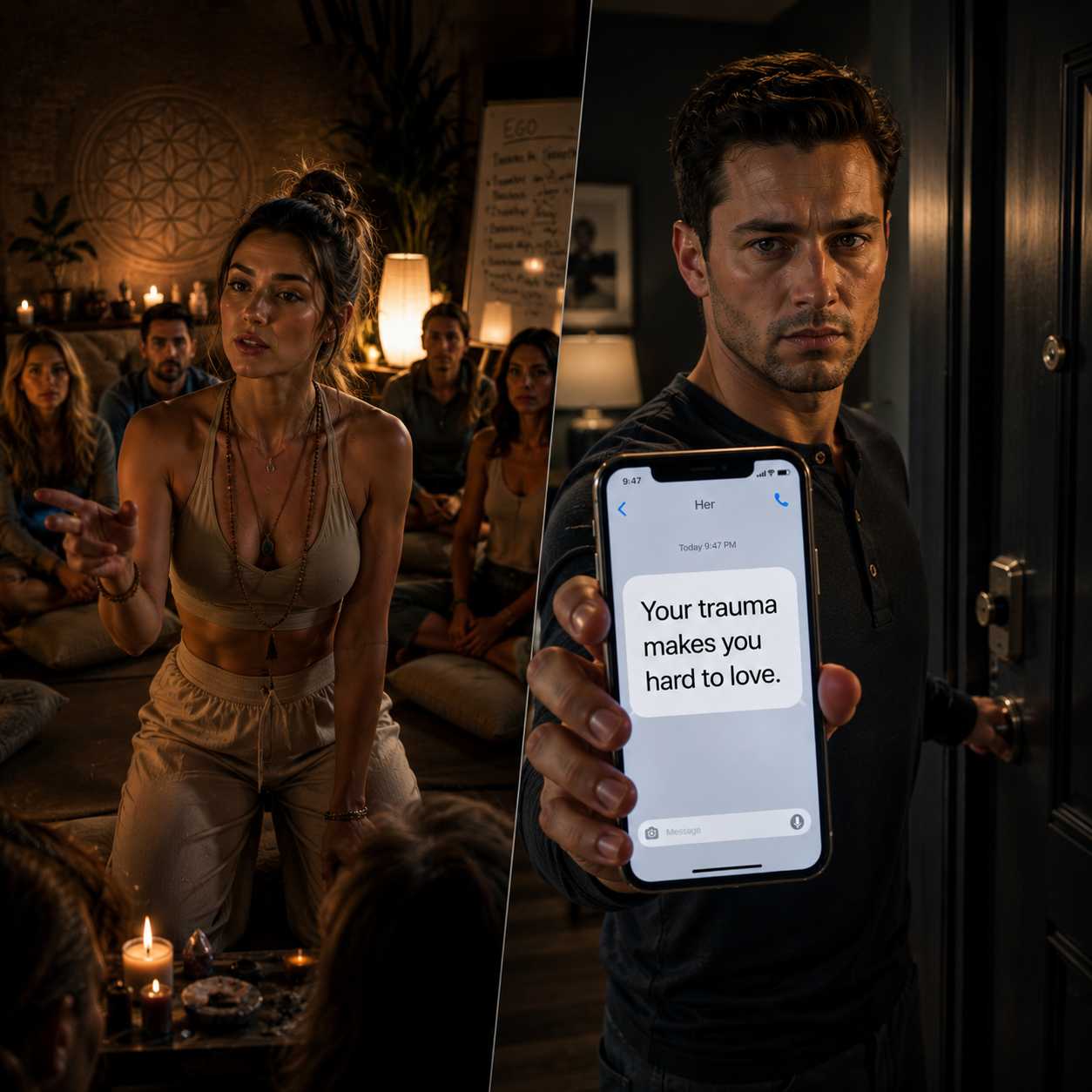
My girlfriend said, "Your trauma makes you hard to love." I said, "Then stopped trying." She thought my past was a weapon she could use whenever I set boundaries. I packed her things, changed the locks, and two weeks later, her healing circle showed up at my job. Original post, I'm Wesley, 34M. My girlfriend Camille, 29F, and I had been together for 2 years and lived together for 8 months in a one-bedroom apartment in Portland, Oregon. The lease was in my name because I had been there before we met, and she moved in after her old roommate got engaged and sold the condo. I work as a claims analyst for an insurance company. Not exciting, but stable. Camille worked as a yoga instructor and part-time wellness coach at a studio called Bloom House. She was the kind of person who could make anything sound profound if she lowered her voice enough.
At first, that felt comforting. She talked about healing, emotional safety, inner work, boundaries, nervous systems. I had a difficult childhood. Nothing I'm going to describe in detail, but enough that I spent years learning how to stay calm when my body wanted to panic. Therapy helped, routine helped, space helped. Having people in my life who did not turn every disagreement into a test helped most. Camille knew this. I told her slowly, carefully, not everything at once. Just enough for someone I trusted. At first, she was gentle with it. Then she started using it. If I got quiet during an argument, she said I was shutting down because of trauma. If I asked for a break before continuing a conversation, she said I was avoiding intimacy. If I said no to something, she said I was letting fear control me. If I disagreed with her in public, she said, "This is your wounded child talking."
The first time she said that, I laughed because I thought she was joking. She was not. The last 3 months were exhausting. Camille had started hosting these small healing circles at our apartment on Tuesday nights. I agreed to it once a month. She turned it into every week. Six or seven people in my living room sitting on floor cushions, drinking herbal tea, talking about energy and truth. I asked her to stop using the apartment for work events without asking me. She said, "You're uncomfortable because community feels unsafe to you." I said, "I'm uncomfortable because strangers are in my living room on a work night." She said, "Same thing." "No, Camille, not the same thing." The final argument happened on a Friday night after one of her studio events. She had invited me because she said it was important that I show up for her world. I went, I smiled. I made small talk with people named River and Sage and one guy named Kyle who kept calling me brother after knowing me for 9 minutes.
Near the end, Camille introduced me to a woman named Nora and said, "Wesley is working through some deep abandonment trauma, so partnership has been a big teacher for him." I froze, not dramatically, just inside. That was not hers to share. Nora gave me that soft pity face people make when they suddenly think they know your whole life. I said, "Camille, don't do that." Camille smiled like I was a child interrupting class. Do what? I said, "Don't discuss my past with strangers." Her smile tightened. Nora backed away awkwardly. Camille waited until we were in the car to explode. She said I embarrassed her in front of clients. I said she shared private information without permission. She said I was projecting old pain. I said she violated trust. We argued all the way home. When we got inside, she threw her keys into the bowl and said, "You make it impossible to love you correctly." I stood by the door, calm, tired. She kept going. I have done nothing but hold space for you, and you punish me for it. Your trauma makes you hard to love. I looked at her. Really looked. Not the woman from the beginning. Not the gentle voice, not the healing language, the person underneath angry because my pain was no longer useful to her. I said, "Then stop trying." She blinked. "What?" I said, "Stop trying to love me. Move out." She laughed once, short, sharp. "You're ending this because I told the truth." I said, "I'm ending this because you keep calling disrespect healing." She said, "You're triggered." I said, "I'm clear." That made her angrier than yelling would have. She said, "You can't kick me out. I live here." I said, "You are not on the lease. You can stay tonight. Tomorrow we'll arrange a pickup plan." She called me cold, broken, emotionally unsafe. Then she locked herself in the bedroom. I slept on the couch badly but peacefully.
The next morning, I had 12 texts from her, even though she was 20 ft away. You're abandoning me. You're proving my point. This is exactly what trauma does. You need help? I replied once. I agree. I need peace. Please arrange a place to stay by tonight. Then I called my landlord, asked about changing access codes, and confirmed what I could legally do. I did not want drama. I wanted the right steps. Camille left that afternoon with two bags and a yoga mat, crying loudly into her phone while standing in the hallway. Before the elevator doors closed, she said, "Everyone is going to know what you did." I said, "Tell them the part where you used my childhood to win arguments." The elevator closed. And for the first time in months, the apartment was quiet. Update 1. 4 days later, the first wave came from her wellness friends, not family, not close friends, her community. Nora messaged me on Instagram first. Hi, Wesley. I know this may not be welcome, but Camille is in deep distress. I hope you can reflect on whether your trauma response is causing harm. I stared at that message for a long time. Then I replied, Camille shared private details about my past with you without my consent. Please do not contact me again. Norah read it. No reply. Then came Kyle. Brother, women who hold space for wounded men often get punished. Think about that. I replied, "Stop contacting me." Blocked. Then Camille's best friend, Lacy, texted me from an unknown number. She says, "You threw her out because she tried to help you heal." I sent one screenshot. "Camille, your trauma makes you hard to love." Lacy typed for a while, then she wrote, "She didn't tell me she said that." I said, "I figured." On day two, Camille sent a long email titled accountability for both of us.
The first paragraph said she was sorry if her words felt hurtful, not hurtful. Felt hurtful. Then came four paragraphs about how my nervous system was protecting me from intimacy. How I had weaponized silence and how she hoped I could one day stop making my partners pay for what other people did. I saved it, didn't reply. The next day, she came to the apartment while I was at work. My doorbell camera caught her standing outside with a tote bag trying the old code. I had already changed it. She tried again. Then she looked into the camera and said, "This is emotional violence." I downloaded the clip. She left a note taped to my door. I won't abandon you even if you abandon yourself. That sentence felt like something from a cult brochure. I took a photo and put the note in a folder. That night, I boxed her things. I folded clothes, wrapped her candles, packed her books, journals, yoga blocks, essential oil diffuser, and the stack of blankets she used for her circles. I labeled every box, clothes, books, studio items, bathroom, kitchen, personal papers. It took 5 hours. The whole time I kept stopping because I would find something small. her mug, a receipt from our first weekend trip to Canon Beach, a scarf she wore the night we met. I was sad that mattered. Leaving someone does not mean you stop feeling. It means you stop letting feeling make decisions that facts already settled. On day four, I emailed Camille. Your belongings are packed. You may pick them up Saturday from 10:00 a.m. to noon. My friend Graham will be present as a witness. Please do not enter the apartment beyond the entryway. She replied within minutes. I'm not coming to a supervised eviction like a criminal, I replied. Then send someone. She sent Lacy. Lacy arrived Saturday in a gray SUV, quiet and embarrassed. Graham stood in the kitchen while I brought boxes to the hallway. Lacy said she's saying you kept her journals. I pointed to the box labeled personal papers. I said, "They're in there. I didn't open them. Lacy nodded. Then she said, "For what it's worth, I told her not to use your trauma in front of people." I looked at her. She said she doesn't listen when she thinks she's right. I said, "I know." When the last box was gone, the apartment looked bigger, emptier, safer. Update two. 3 weeks later. 3 weeks later, Camille escalated from emotional language to actual consequences. She contacted my workplace. My manager, Aaron, called me into a small conference room with HR. My stomach dropped because nothing good starts with HR and a closed door. Aaron said, "We received an email from someone named Camille. She says she is concerned about your emotional stability and that you may need support." I closed my eyes for one second. Then I asked, "Did she mention she is my ex-girlfriend?" HR said, "Not directly." "Of course." I said she is my ex. We broke up after she shared private details about my past in a professional setting and then used them during an argument. I have asked her not to contact me. HR asked if I had documentation. I almost laughed. I had a folder in my backpack because by then the folder came everywhere. Screenshots, emails, doorbell clip, the note, pickup messages, the original text where she called me hard to love.
Aaron reviewed everything and said, "We'll block her email from contacting the company. If she appears in person, security will handle it." I said, "Thank you." Then I went back to my desk and stared at a spreadsheet for 20 minutes without seeing a single number. That night, Camille posted a long caption online. No names, but clearly me. It talked about loving someone trapped inside unprocessed trauma, being punished for compassion, and learning that not everyone wants to be healed. People commented, "Harts! So brave. You gave so much." Some people fear light. I did not respond, but my cousin Dana did. Dana has known me since we were kids. She knows enough about my past to understand why Camille's post was not just annoying, but cruel. Dana commented, "Sharing someone else's trauma to make yourself look like the healer is not love." The post disappeared within an hour. Then Camille texted Dana, "You have no idea what I survived in that relationship." Dana sent me the screenshot and wrote, "Want me to block?" I replied, "Yes." Then came the fake crisis. Camille emailed me at 148 a.m. Subject line emergency. The message said she was outside my building overwhelmed and did not feel safe being alone. My first instinct was to go downstairs. That is the hook in these situations. They know the part of you that still cares. Instead, I called 911 for a welfare check. If she was truly unsafe, help would come. If she was trying to pull me outside, help would come. Either way, I was not going down alone. The police arrived. Camille was not outside. The building lobby camera showed her car driving through the lot at 136 and leaving at 141. 7 minutes before the email. I saved the camera clip. The next morning, she sent another message. I can't believe you sent police instead of coming yourself. I replied once. Do not contact me again.
Then I hired an attorney named Brooks. The consultation was $275. The cease and desist letter was $425. It instructed Camille to stop contacting me, my employer, my family, and my friends, and to stop publicly referencing private details about my personal history. The letter also warned that any further workplace contact would be treated as harassment. Camille responded by sending Brooks a 7-page impact statement about how my avoidance had wounded her. Brooks forwarded it to me with one sentence. Do not respond. I didn't. Two weeks later, Camille showed up at my building again, this time with Kyle and another woman from Bloom House. They stood in the lobby asking the front desk if I was home. The building manager, Marsha, already had her photo. Marsha is in her 60s, wears bright lipstick, and has zero patience for nonsense. She told them to leave. Kyle said they were there for a healing conversation. Marsha said, "This is an apartment lobby, not a group project. I wish I had heard it live." They refused to leave for almost 10 minutes. Marsha called security. The lobby camera recorded everything. That was enough. Brooks helped me file for a protective order. I felt embarrassed doing it. That surprised me. Part of me still heard Camille's voice saying I was overreacting, triggered, avoidant, broken. Then Graham said, "People who respect boundaries don't need court orders explaining them." That stayed with me.
Final update. 3 months later, the hearing was 6 weeks after the lobby incident. Camille arrived wearing white linen, hair pulled back, no makeup, looking like someone on the cover of a meditation retreat brochure. Lacy came with her but sat far behind, not beside her. I came with Brooks Graham and a folder that had become almost ridiculous in size. The judge asked Camille why she contacted my workplace. She said, "I was worried about him." Brooks asked, "Were you worried before or after he ended the relationship?" Camille said trauma makes people push away care. The judge looked up. Please answer the question, Camille said after. Then Brooks showed the text, "Your trauma makes you hard to love." Camille said, "That was taken out of context." Brooks showed the email to my workplace. Then the doorbell clip, then the note, then the late night emergency email, followed by lobby footage showing she had already left. Then the video of her group in my lobby. The judge asked Camille why she brought other people to my home. Camille said he responds better when community is present. I almost laughed. The judge did not. He granted a one-year protective order. No contact, no third-party contact, no workplace contact, no coming within 300 ft of my home, job, or vehicle. He specifically included online posts referencing my private history in identifying ways. Camille cried when he said that. Not loud, just enough. Afterward, Lacy approached me in the hallway. Brook stepped forward, but I said it was okay. Lacy said, "I'm sorry. I thought you were just shutting down. I didn't understand how far she took it." I said, "I appreciate that." She said she thinks boundaries are abandonment when they're not hers. That was the most accurate thing anyone had said all year. I moved apartments when my lease ended.
I did not have to, but I wanted a place Camille had never entered. I found a smaller studio in Beaverton with big windows, terrible kitchen cabinets, and a view of a parking lot that somehow still felt peaceful. I started therapy again, not because Camille was right about me being broken, but because she had reopened old alarms I had worked hard to quiet. That is something people do not talk about enough. When someone weaponizes your trauma, the damage is not only in the insult. It is in the way it makes you distrust your own healing. I had spent years learning how to name my feelings, ask for space, stay present, and build healthy routines. Camille took the language of healing and turned it into a leash. For a while, I questioned every boundary I set. Was I triggered? Was I avoidant? Was I unfair? Was I punishing her for someone else's actions? My therapist listened to the whole story and said, "A trauma response can be real and a boundary can still be valid." That sentence did more for me than any motivational quote ever has. Life is calmer now. I got promoted to senior claims analyst after handling a messy audit that everyone else avoided. I started hiking on Saturday mornings with Graham. I bought a new couch that is too firm but mine. I deleted every wellness podcast Camille made me feel guilty for not liking. I also started seeing someone named Renee slowly. She is 32, works as a librarian and asks normal questions like, "Do you want to talk about it or be distracted?" The first time I said, "I need a minute before we continue this conversation." She said, "Okay." "Do you want 10 minutes or 20?" I almost cried.
Not because it was dramatic, because it was easy. That is what I'm learning now. Love should not require you to defend your survival skills every week. It should not turn your past into a courtroom where your partner gets to act as judge, therapist, and victim. It should not make privacy look like dishonesty or boundaries look like abandonment. The lesson I took from all of this is simple. Someone can know your pain and still not be safe with it. Someone can use all the right language and still do harm. Healing words do not excuse controlling behavior. A person who truly loves you will not expose your wounds to prove they are the healer. They will not turn your history into a weapon every time you say no. I'm not ashamed of what happened to me before Camille, and I am not ashamed of leaving when she used it against me. Both things are part of the same healing.
![[FULL STORY] Girlfriend Invites Her Ex to My House Party — What Happened Next Ended Everything](https://social.greatgames.info/storage/thumbnails/1776417735_671150455_1913188989634267_5561232053519203456_n.jpg)
![[FULL STORY] He Told Me No One Would Believe Me—So I Made Sure Everyone Saw the Truth](https://social.greatgames.info/storage/thumbnails/1777621174_fc1b69bf-f607-4583-afda-73b72ee21ffa.png)
![[FULL STORY] She Dumped Me but Still Wanted My House Key, My Streaming Accounts, and the Right to Be Jealous. I Said, “Friends Don’t Get Boyfriend Privileges](https://social.greatgames.info/storage/thumbnails/1777347096_M8.png)

![[FULL STORY] My Influencer Girlfriend Tried To Humiliate My Traditional Parents To Prove A Point, So I Silently Systematically Decimated Her Entire Golden Life.](https://social.greatgames.info/storage/thumbnails/1777345293_D2.png)