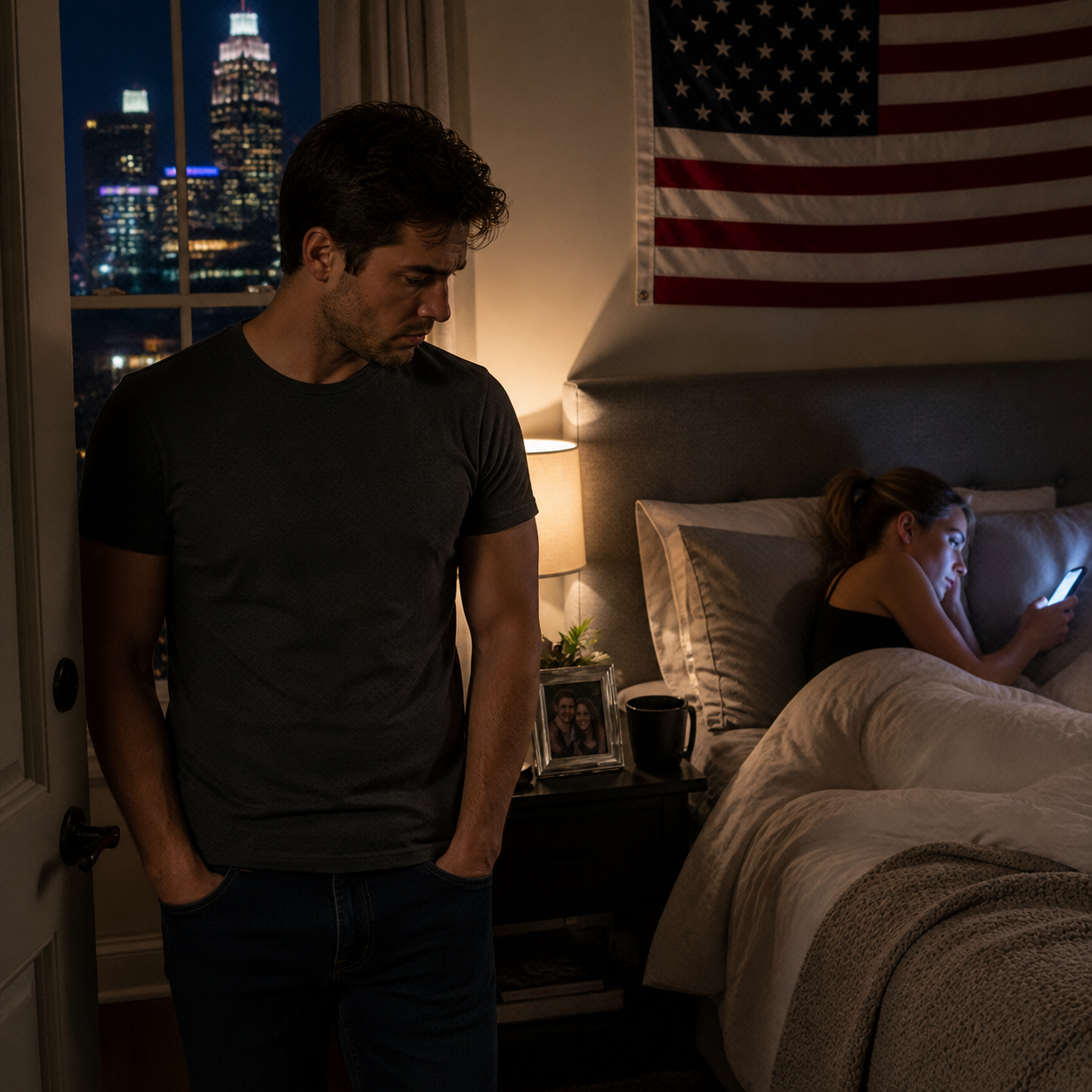

"If you really loved me, you wouldn't be looking for the exit right now. You’d be on your knees convincing me to stay."
That was the bombshell Chloe dropped on me across a candlelit table at Vittorio’s, the same Italian place where we’d celebrated our first six months together. But as I sat there, looking at the woman I’d shared my life with for over a year, I didn't see the person I loved. I saw a puppet. I saw a woman reading lines from a script that wasn't hers, waiting for a reaction she’d been told to expect.
I’m Ethan. I’m 34, a software architect by trade, which means my brain is wired for logic, systems, and debugging. If a program isn’t working, you find the bug and fix it. You don't play games with the code. I’ve carried that philosophy into my personal life. I don't do mind games, I don't do "hints," and I certainly don't do "tests."
When I met Chloe two years ago at a tech conference, she was a breath of fresh air. She was a marketing lead, sharp, funny, and seemingly grounded. For the first eight or nine months, we had what I thought was the gold standard of relationships. We communicated. If something was wrong, we talked it out over coffee. There was no drama, just an effortless connection that made me think, This is it. This is the one.
But then, the "committee" started to infiltrate.
Chloe had three best friends from her university days: Maya, Zara, and Phoebe. I call them the "committee" because, eventually, every decision in our relationship had to pass through their board of directors.
Maya was the "Relationship Coach" of the group, though her own track record was a graveyard of three-month flings. She was obsessed with "High-Value Man" TikTok and "Dark Feminine Energy." Her philosophy? Men are biologically wired to be hunters, so if you don't keep them chasing, they lose interest.
Zara was the "Detective." She was the one who convinced her boyfriends that she was constantly being stalked or harrassed just to see if they’d quit their jobs or fly across the country to "protect" her. She lived for the "Grand Gesture" bought with the currency of manufactured crisis.
And then there was Phoebe. Phoebe was the "Scientist." She talked about attachment styles like they were religious dogmas. She had color-coded spreadsheets of her exes’ flaws and spent her weekends analyzing the "micro-expressions" of men in bars.
The first time I met them all together was at a brunch about ten months into dating Chloe. I remember the atmosphere shifting the moment they sat down. It wasn't a conversation; it was a deposition.
"So, Ethan," Maya started, swirling her mimosa. "Chloe says you’re a software architect. That’s... stable. But do you have the 'provider' mindset? Like, if Chloe wanted to quit her job tomorrow to pursue pottery, would you cover 100% of the lifestyle she’s accustomed to?"
I laughed, thinking it was a joke. "Well, I’d support her dreams, but we’re a team. We’d sit down and look at the budget together."
The table went dead silent. Zara exchanged a look with Phoebe.
"A team?" Zara asked, her voice dripping with fake concern. "That sounds a bit... transactional. Don't you think a woman should feel completely taken care of without having to look at a budget?"
"I think a woman should be a partner, not a dependent," I replied calmly. "And Chloe is one of the most capable people I know."
Chloe didn't say a word. She just sipped her water, her eyes darting between her friends. That was the first "bug" in the system I noticed. She wasn't defending our dynamic; she was observing it through their lens.
Over the next few weeks, the "tests" began. They were subtle at first. Chloe would text me at 2:00 PM on a Tuesday saying, "I’m having a really bad day. I wish someone would surprise me."
When I’d call her to ask what happened and offer to bring dinner later, she’d be cold. "Forget it. If you have to ask what I need, the moment is gone."
Later, I’d find out from her sister, Elena—who actually liked me—that Maya had told Chloe that a "real man" would have left work immediately and shown up at her office with flowers without a single question asked.
"Ethan, be careful," Elena warned me over the phone one evening. "I overheard them at the spa. They’re treating your relationship like a social experiment. They’ve convinced Chloe that you’re 'too comfortable' and that you need to be 'shaken up' to see if you’ll truly fight for her."
I wanted to believe Chloe was stronger than that. I wanted to believe that the woman who debated philosophy with me until 3:00 AM wouldn't fall for "Girl Boss" manipulation tactics. But the hypotheticals became more frequent.
"What would you do if my ex called me tonight?" "If we were in a sinking boat and there was only one life jacket, would you give it to me?" "Do you think it's okay for a man to have female friends, or is that just a way to keep his options open?"
Each question felt like a trap. If I gave the logical answer, I was "emotionally unavailable." If I gave the romantic answer, I was "trying too hard." There was no winning.
The breaking point started a week before our one-year anniversary. Chloe had been distant, constantly on her phone, her thumb flying across the screen in what I assumed was the group chat from hell. Every time I tried to plan our dinner, she’d shrug. "Whatever you think is best. Let’s see how much effort you put in."
I decided to go all out. Not because I wanted to "pass a test," but because I actually loved her. I booked a private booth at Vittorio’s, ordered her favorite vintage of wine, and even had the florist prepare a bouquet of the specific lilies she’d mentioned once months ago.
When she walked into the restaurant that night, she looked stunning in a black silk dress. But her eyes were cold. She didn't look at the flowers. She didn't look at me. She looked at her phone.
She set it face-down on the table, but the haptic feedback was buzzing every thirty seconds. Buzz. Buzz. Buzz. It was like a third, fourth, and fifth person was sitting at the table with us.
"Ethan," she said, her voice strangely formal. She didn't even open the menu. "We need to talk about where this is going. I’ve been thinking... and I don't feel like you’re truly invested in our future."
My heart sank. Not because of the words, but because of the delivery. It was flat. Rehearsed. It sounded exactly like the "Relationship Audit" script Maya had posted on her Instagram story the day before.
"Chloe, it’s our anniversary," I said softly. "I’ve spent the last year showing you I’m invested. What is this really about?"
She took a deep breath, her hand trembling slightly as she reached for her phone, checked a notification, and then put it back down.
"It's about the fact that I think we should break up," she said, looking me dead in the eye. "Unless you can give me a reason why I should stay."
She sat back, crossing her arms, her face a mask of expectation. She was waiting. She was waiting for me to gasp, to reach across the table, to beg her to reconsider, to promise her the world. She was waiting for the "Grand Gesture" that the committee had told her she deserved.
But as I looked at her, I noticed something. The screen of her phone, face down on the tablecloth, lit up with a message that bled through the edges. It was a text from the group chat. It said: "Now. Use the line about the 'passion gap.' Don't back down."
The realization hit me like a physical blow. This wasn't a conversation. This was an interrogation, and she was just the mouthpiece.
But she didn't know that I had already made a decision of my own.
![[FULL STORY] My Girlfriend Said “I’m Not Ready For Boring Couple Life With You. I Want Fun.” So I Gave Her ...](https://social.greatgames.info/storage/thumbnails/1776396874_7af2f747-f422-4ca2-b3fb-202cd2c48099.png)
![[FULL STORY] She Ran From the Altar Into the Arms of a Wanted Criminal — Less Than 24 Hours Later, She Was in Handcuffs](https://social.greatgames.info/storage/thumbnails/1776615650_6c16e731-7e2b-422e-8bd9-eef1d9412b47.png)
![[FULL STORY] She Called Me Pathetic at Her Parents’ Party — So I Walked Away and Never Looked Back](https://social.greatgames.info/storage/thumbnails/1776653421_8fb4d548-cb4b-4dfb-827b-af7920a5ae67.png)
![[FULL STORY] How I Took Back My Home, Car, And Life After My Cheating Girlfriend Told Me I Had No Right To Interfere.](https://social.greatgames.info/storage/thumbnails/1777880922_C6.jpg)