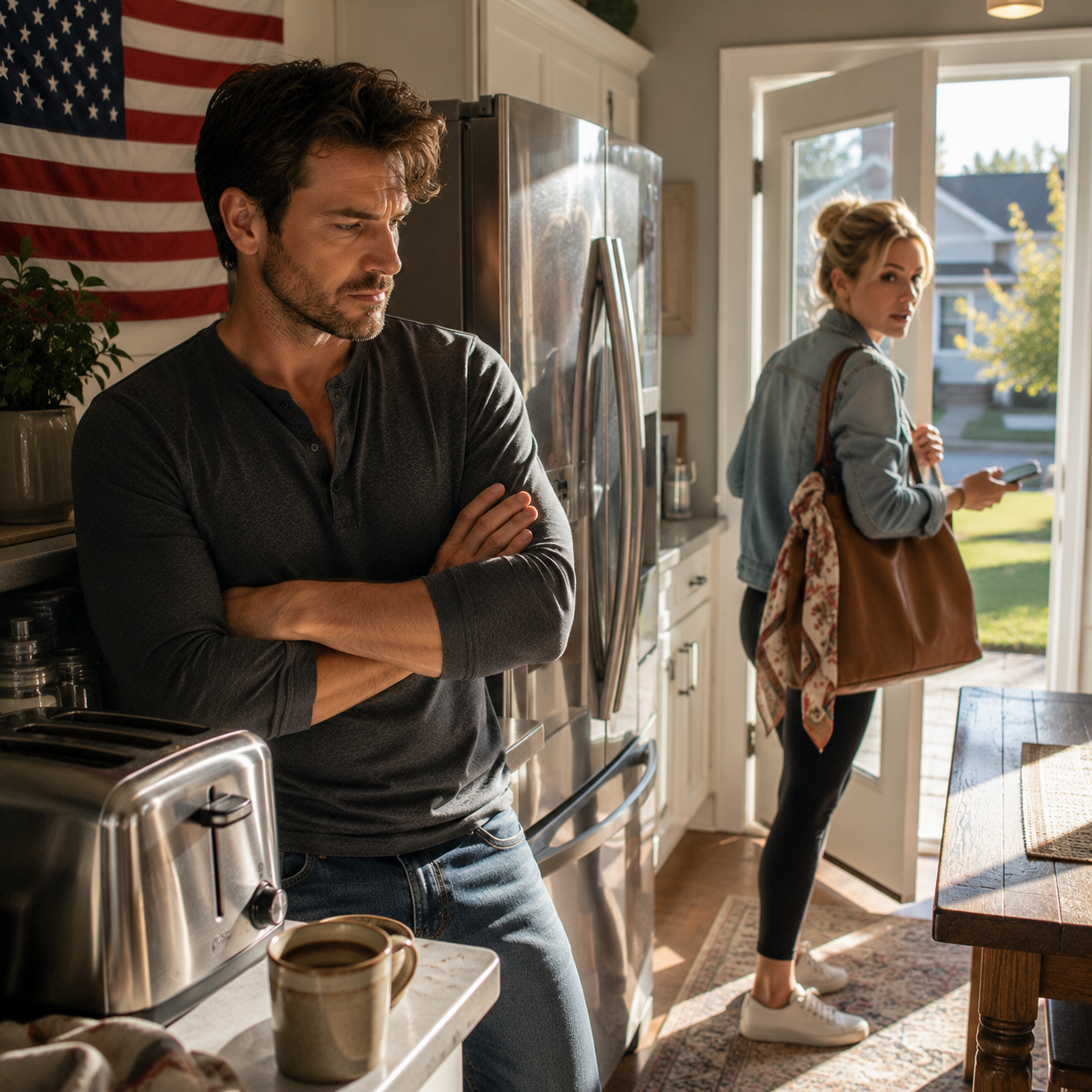
“You’re fine, right? First time for everything,” I said, leaning my shoulder against the stainless steel of the fridge. I watched Elias—no, I watched myself in the reflection of the toaster. I looked like a man who was still trying to convince himself that a crack in the drywall was just "settling."
Sarah stood in the doorway, her tote bag half-unzipped, spilling out a mess of chargers, lip gloss, and a silk scarf I hadn't seen her wear in years. She was heading to Jenna’s. Again. This was the third "emergency vent session" in two weeks.
“We actually want to talk for once,” she said, her thumbs flying across her phone screen. She didn’t look up. “No husbands, no schedules, no talk about the clinic’s quarterly KPIs. Just… us. You’re sure you’re okay?”
“I’m a big boy, Sarah. I think I can handle a microwave and a remote control for twelve hours,” I replied. I tried to keep my tone light, but in my head, I was already checking the "Patterns" folder. I run a small home renovation crew. My entire life is built on noticing when things aren’t level. And right now? The floor was tilting.
“Do you want me to pack you a toothbrush, or are you planning on borrowing a communal one like a true rebel?” I joked.
She didn’t laugh. She didn’t even offer a polite smirk. She just rolled her eyes and tucked a strand of perfectly highlighted hair behind her ear. “I’m serious, Elias. It’s been a week. I need this. Take the car.”
“No,” I said, crossing my arms. “I’ll Uber to the shop in the morning. You take the SUV. It’s safer for you to have your own wheels if you guys decide to move the party.”
Her brow flicked. It was a micro-expression I’d seen her use when a client at her marketing firm pushed back on a budget. “No, I’ll get a ride. We’ll share a taxi. It’s safer if we split it. Don’t be so… managing.”
“Do what you want,” I said. “Lock up.”
If I had known where that sentence was headed—if I had known that "doing what she wanted" involved the systematic destruction of our nine-year marriage—I would have kept the car keys in my pocket, locked the door, and called a therapist. Or a lawyer. Probably both.
We were the "Practical Couple." That was our brand. People asked us to host the neighborhood barbecues because we had the heavy-duty folding chairs and we never fought in front of the kids. I built things that lasted; she marketed things that people needed. It was a balance. But lately, the marketing was getting aggressive, and the construction was failing.
She left a minute later. The porch light cut a sharp, yellow triangle onto the driveway as she walked toward the street. She didn’t look back. She left behind a cloud of expensive perfume that hung in the entryway like she expected an standing ovation for her departure.
The next morning, I was at the shop by 5:30 AM. I brewed a pot of coffee that tasted like battery acid and sent a text. “You alive?”
Ten minutes passed. Then twenty. At 6:15, she replied: “Coffee at Jenna’s. Heading to the clinic from here. You good, Boss?”
I stared at the word "Boss." It was a new nickname. It felt clinical. It felt like a receipt for a transaction I didn’t remember making. “Save me a crumb from your deep emotional growth,” I wrote back.
She sent a laughing emoji. It was the digital equivalent of a pat on the head.
The first real crack in a marriage isn't usually a scream. It’s not a plate breaking against a wall. It’s the way your spouse starts talking to you like you’re part of the furniture. I was becoming the recliner in the corner—reliable, stationary, and completely ignored unless she needed a place to dump her coat.
A week later, the pattern solidified. She came home at 10:00 PM, her heels in her hand, her eyes bright in a way they never were when she looked at me. She tossed a “don’t wait up next time” over her shoulder like it was a line she’d rehearsed in the car.
I was on the couch, surrounded by blueprints and estimates for a kitchen remodel in the Highlands. “You missed dinner,” I said, not looking up from my laptop.
“I grabbed a salad with Ellie,” she said, her voice trailing off as she walked down the hall.
“What about tomorrow?” I called out. “We said we’d go to Dan’s thing, right? The housewarming?”
She stopped at the end of the hallway. Her silhouette was sharp against the white paint. “I might be slammed. We’ll see.”
I closed my laptop. The sound of the plastic snapping shut was the loudest thing in the room. “Translate ‘We’ll see’ for me, Sarah. Because in my world, that’s what we say to clients when we don’t want to tell them their foundation is rotted.”
She turned, arching one eyebrow. “It means we’ll see, Elias. Don’t be so… intense. It’s just a party.”
“I’m not being intense,” I replied, standing up. “I’m being married. There’s a difference.”
She shrugged, a cold, dismissive motion. “Then be flexible.”
The word "flexible" sat on my tongue like a dare. In the construction world, if a beam is too flexible, the roof collapses. I watched her disappear into the bedroom and realized I was standing in a house that was starting to moan under the weight of her secrets.
Two days later, I decided to test the structural integrity of this new "flexibility." She texted me at 4:30 PM: “Running behind. Don’t wait for me for dinner. Busy night.”
Usually, I’d offer to bring her something. I’d ask if she was okay. Not this time. “No problem,” I replied. “I’ve pushed our Friday dinner at Hank’s to 6:30. No phones. Early night. We need to touch base.”
Five minutes later: “?” Then: “That’s sweet. I’ll try to make it.”
“You’ll try?” I muttered to the empty shop. I set a new rule in my head right then. I wasn't chasing anymore. If she wanted a seat at the table, she could find the door herself.
Friday came. I was seated at Hank’s by 6:25. I ordered a bourbon, neat. I watched the clock. 6:30. 6:40. At 6:50, she swept in. Her hair was perfect, her smile switched on like a stage light, but her eyes were scanning the room for everyone except me.
She dropped into the booth and leaned over to kiss my cheek. She smelled like peppermint and someone else’s car.
“Traffic was awful,” she said, handing the hostess her coat without looking at her.
“Traffic doesn’t apply inside a bar, Sarah. I’ve been sitting here for twenty-five minutes.”
She didn’t apologize. She just opened the menu and started humming. A couple at the next table laughed too loud. The clink of silverware felt like a headache.
“I’m checking something for tomorrow,” she said, pulling her phone from her purse and sliding it under the table.
“Put it away,” I said. My voice was low, the tone I use when a sub-contractor tries to cut corners on a load-bearing wall.
She stiffened. “I’m just—”
“No phones. New house rule,” I said. “Tomorrow can wait an hour. I’m right here.”
She slid the phone back into her purse with a sharp, metallic click. “I’m not a child, Elias.”
“Good,” I said, taking a sip of my drink. “Then the rule fits.”
That earned me a thin, brittle smile. For the next hour, she performed. She talked about paint colors, a new campaign her team was running for a local clinic, a funny thing a nurse had said. She was a marketing genius, after all. She knew how to fill the air with words that meant absolutely nothing. She avoided "us" like it was a contagious disease.
I decided to probe the wound. “Your sister called me today. About Thanksgiving.”
The smile cracked. A tiny, jagged line. “Lauren called you?”
“She wanted to coordinate. Asked if I was bringing the smoker this year. I told her we’d think about it.”
“Don’t commit to things for me,” Sarah said, her voice suddenly sharp. “I don’t know what my schedule looks like in November.”
“I didn’t commit,” I said. “I told her you’d get back to her. Which you haven’t done in three days, by the way. She’s worried about you.”
Sarah spread a cloth napkin over her lap, her movements stiff and jerky. “I will. Everyone needs to just… calm down.”
“I’m perfectly calm,” I said. “I’m just noticing things.”
She exhaled a long, shaky breath through her nose. “Then notice quietly.”
The server arrived with our food, and the conversation died an unceremonious death. We ate in a silence so thick it felt like wet cement. On the drive home, she stared out the passenger window like the very sight of our neighborhood was an insult to her existence.
“You look like you’re studying a crime scene,” I said as I pulled into the driveway.
“I’m tired, Elias. That’s it. I’m just tired.”
“That’s been your headline for a month, Sarah. Do you want me to stop planning anything after 6:00 PM? Is that the new deal?”
She snapped. She turned in her seat, her face illuminated by the harsh blue light of the dashboard. “I want you to understand that my life doesn’t revolve around your 7-to-3 shop schedule! I have a career! I have friends! You’re… you’re smothering me!”
I killed the engine. The silence that followed was heavy. “I took you to dinner, Sarah. If that’s smothering, the bar for this marriage is officially on the floor.”
“Maybe the bar needs to be low for you to reach it,” she said. It was almost playful, a cruel flick of the tongue, but she caught herself and shut her mouth instantly.
I felt something cold settle in my chest. “There it is,” I said quietly. “The mystery solved. I’m the problem.”
“I didn’t say that,” she whispered.
“You didn’t have to.”
She didn't wait for me to open the door. She marched into the house, grabbed her laptop, and went straight to the guest room. “I have to finish a deck for Monday,” she called out.
“Finish your deck,” I replied to the empty hallway.
I stayed in the kitchen and made a new rule—one I didn't bother announcing. No more waiting up. No more warm plates. I’d cook what I ate, and she could forage like a raccoon at midnight. But as I sat there in the dark, I realized that "noticing quietly" wasn't going to be enough. I needed to see exactly what Sarah was marketing to the rest of the world while I was left with the leftovers.
Because a week later, at a backyard barbecue with our oldest friends, she said something that made the "flexible" beam in my chest finally snap.
![[FULL STORY] My “Mental Health Weekend” Was a Lie… So I Ended the Relationship While She Was Away](https://social.greatgames.info/storage/thumbnails/1777146369_8d08d33d-2483-41d8-b7fa-ae7d8356ea4c.png)
![[FULL STORY] My Fiancée Announced: 'I'm Moving in with Anthony, and We're Expecting a Baby ' I Responded](https://social.greatgames.info/storage/thumbnails/1777303181_T1.png)
![[FULL STORY] He Said No One Would Believe Me, So I Let His Own Voice Tell the Truth](https://social.greatgames.info/storage/thumbnails/1777490888_2722ff2f-c2f8-49ea-859c-29b4b12b3c9d.png)
![[FULL STORY] My Girlfriend Said, “I Need Closure First.” I Replied, “Then I’ll Go Alone.” I Canceled Her Ticket,](https://social.greatgames.info/storage/thumbnails/1776672483_1.png)