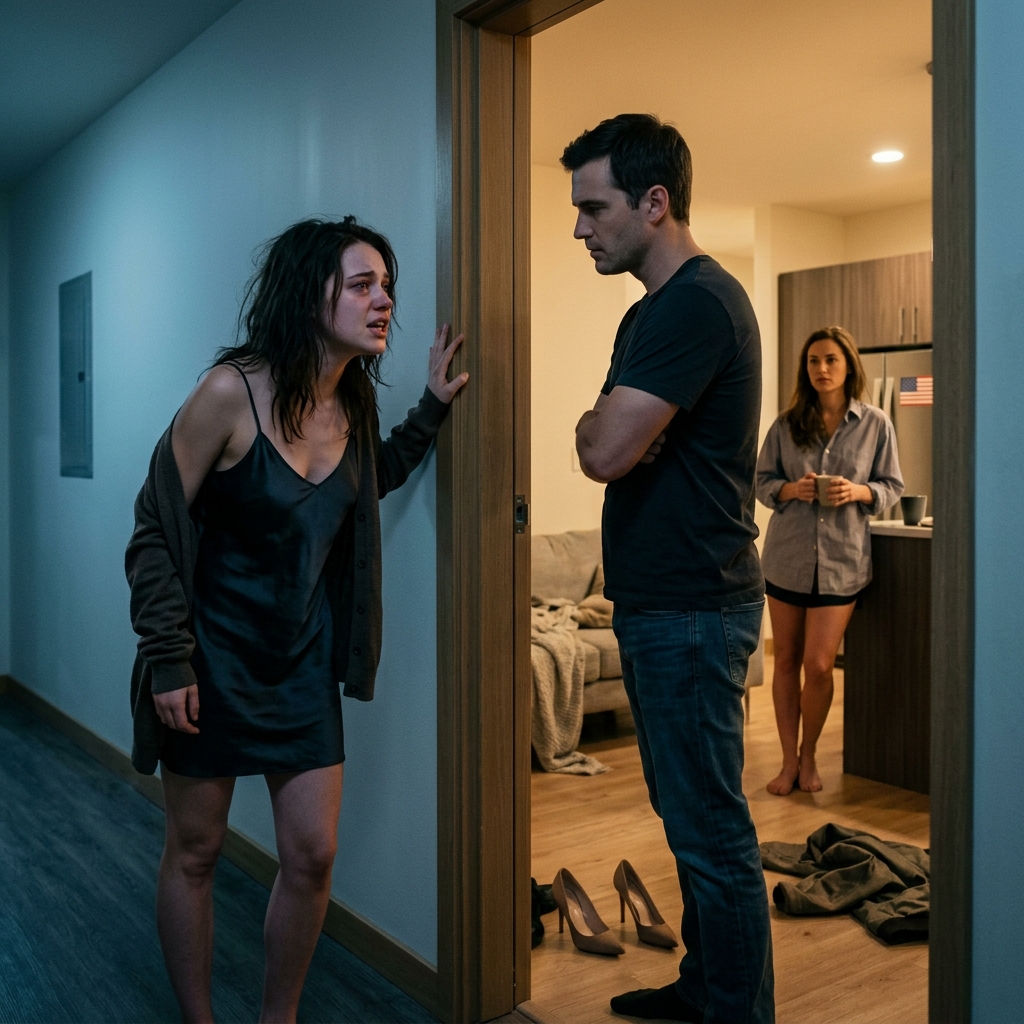

"If you’re going to treat me like a ghost, Claire, don’t be surprised when I decide to haunt someone else’s house."
I didn’t say that out loud. Not that night. I just stood there in the entryway of our home, holding a bag of lukewarm orange chicken and my Leica camera bag, feeling my dignity evaporate like steam. My name is Julian. I’m thirty-four, and for the last six years, I’ve been married to Claire. Or at least, I thought I was married to her. As it turns out, I was just a domestic accessory she kept around to provide a sense of stability while she and her friends played god with people's lives.
I used to be an artist. A real one. I spent my twenties chasing light in the back alleys of Prague and the neon-soaked streets of Tokyo. My work was featured in Aperture and The New Yorker. But Claire… Claire is a "Master of Marketing." And she marketed a version of life to me that involved safety, a mortgage, and "practicality." Slowly, I traded my soul for a steady paycheck doing corporate headshots—photographing stiff men in suits who didn't want to be there, for a man who didn't want to be there either.
Claire’s world revolved around "The Board." That’s what I called her group of friends—five women who met every Thursday for a "Book Club" that was really just a tribunal for their husbands. There was Jessica, the loud-mouthed instigator; Monica, the one who pretended to have a heart; and three others who were basically Claire’s echoes.
Two weeks ago, on a Thursday, I came home early. I was excited. I’d just landed a massive contract for a tech firm, and I thought maybe—just maybe—this would be the night Claire and I finally reconnected.
I walked into the living room. The laughter was deafening. Wine glasses were clinking, and the smell of expensive Chardonnay filled the air.
"Hey everyone! Sorry to crash the party," I said, putting on my best "good husband" smile. "I brought dinner if anyone’s hungry."
The silence wasn't gradual. It was a guillotine.
Five women turned their heads. They looked at me—straight at my face—and then their eyes went completely blank. It was like I’d been edited out of a photo. No one blinked. No one said "Hi Julian." They just… stopped existing in my direction.
"Claire?" I said, my voice cracking slightly.
My wife took a slow, deliberate sip of her wine. She looked at a spot on the wall three inches to the left of my ear. She didn't acknowledge me. Not even a twitch of her lip. After sixty seconds of bone-chilling silence, she turned back to Jessica and said, "So, as I was saying, the quarterly projections for the firm are looking excellent."
The conversation resumed as if I hadn't spoken. I stood there for two more minutes, feeling like a fool, before I retreated to my office. I spent the night on the small sofa in there, waiting for her to come up and tell me it was a joke.
She didn't.
The next morning was the same. I said "Good morning." She scrolled through LinkedIn. I asked if she wanted coffee. She stood up and walked out the door. This went on for three days. On the fourth day, while she was in the shower, her phone buzzed on the nightstand. I’m not a snooper, but I was desperate.
It was a text from the "Book Club" group chat. Jessica had written: “Day 4. How’s the Invisible Man doing? Is he breaking yet?”
Claire’s reply sent a chill through my marrow: “Not yet. But give it time. We voted for 30 days. He needs to learn that he doesn't get to ignore my needs and expect me to be his cheerleader. He’ll be begging for a conversation by next week.”
I set the phone down. My hands weren't shaking. They were cold. I realized I wasn't married to a partner; I was married to a warden who used silence as a cage.
But as the days crawled by, something strange happened. Instead of breaking, I started to breathe. Without Claire’s constant critiques of my "failed art career" or her "suggestions" on how I should dress, I felt light. I went to the garage and dug out my old darkroom equipment. I spent my evenings in the silence she provided, rediscovering the textures of black and white film.
I stopped trying to talk to her. I made my own meals. I did my own laundry. I moved into the guest room. And by Day 10, I felt more like Julian the Artist than I had in a decade.
On Day 12, I decided to check my old professional email—the one Claire told me was "dead weight" and that I should just delete. I hadn't checked it in eighteen months.
I had to reset the password. When the inbox finally loaded, my heart stopped.
There were 42 unread messages. “Julian, are you still interested in the Berlin residency?” “Request for prints: ‘The Shadows of Prague’ series.” “URGENT: Regarding your submission to the National Arts Grant.”
My eyes blurred. I went into the settings. And there it was. A forwarding rule. Every single email sent to my professional account was being automatically forwarded to [email protected] and then marked as read and archived in my inbox.
She hadn't just been ignoring me for two weeks. She had been sabotaging my life for years.
I sat there in the dark, the blue light of the monitor reflecting off my face. I realized that the "Silence Protocol" wasn't just a lesson—it was a smoke screen. She wanted me small, dependent, and quiet so I wouldn't notice she was stealing my future.
I spent that night downloading every bit of evidence. I took screenshots of the forwarding rules. I tracked the IP addresses. I documented everything.
But I wasn't going to confront her yet. No. If she wanted 30 days of silence, I was going to give her exactly what she asked for—but I was going to be the one who decided when the silence ended.
I reached out to an old contact, a curator named Marcus. Within an hour, he responded. "Julian! Where have you been? I thought you’d retired! I have a gallery opening in three weeks and a spot just opened up. Can you give me twenty pieces?"
"I’ll give you thirty," I replied.
That night, for the first time in years, I didn't sleep in the house. I drove to a motel, took my camera, and shot the city until the sun came up. When I returned home at 8 AM, Claire was sitting at the kitchen table, her eyes red, her jaw tight. She looked like she wanted to scream. She looked like she was the one who was breaking.
I walked past her without a glance, grabbed a clean shirt, and headed back out.
She thought she was teaching me a lesson about my place in her world. But she didn't realize that I was already building a world where she didn't exist at all. And the next step of my plan was going to involve a very different kind of "Book Club"—one that involved a lawyer and a very thick stack of legal documents.
But as I pulled out of the driveway, I saw something in the rearview mirror that made my blood run cold.
![[FULL STORY] They Forced Me to Sign Divorce Papers While I Was 8 Months Pregnant… They Didn’t Know It Would Cost Them $16 Million](https://social.greatgames.info/storage/thumbnails/1776756165_D70.jpeg)
![[FULL STORY] SHE THOUGHT MY SILENCE MEANT WEAKNESS, UNTIL I PLAYED HER VOICE AT DINNER](https://social.greatgames.info/storage/thumbnails/1777820523_690025715_994349716450564_702928747693197533_n.jpg)
![[FULL STORY] I Found Her Secret Messages, Then Exposed the Affair at Her Own Company Event](https://social.greatgames.info/storage/thumbnails/1777479341_91407628-8522-43ba-ba48-84d212419b35.png)
![[FULL STORY] My Wife Took Off Her Ring at Dinner, Then Vanished With My Business Partner](https://social.greatgames.info/storage/thumbnails/1777489996_a8ca7ff8-7e65-4e2d-bb80-e37db17a9f2b.png)
![[FULL STORY] “I Can’t Live In This Dump—Let’s Break Up,” My Girlfriend Said After Visiting My Parents’ 1970s](https://social.greatgames.info/storage/thumbnails/1776412829_9e5f927e-074e-4255-bdab-d128e10e0e38.png)